Run herdr
from anywhere.
On your desktop and your phone. A browser and phone client for herdr: open the sessions you already run, read what your agents are doing, and answer them from wherever you are.
curl -fsSL https://herdrweb.dev/install.sh | shOne pane, every screen
recorded liveClaude Code asks in herdr's terminal; the browser and the phone show the same question. One tap on the phone answers it, and the terminal moves on by itself. Recorded live on one herdr session, with no cuts.
Chat and terminal, one pane.
Native Claude Code, Codex, omp, omo, gjc and pi transcripts, with the live terminal a click away. The chat is built from the agent's own session file, not from screen text, and each turn's commands and edits fold into one block. Write the next message while the agent works: it goes in with the next turn, or at once with Send now.
Approve with a tap.
Approvals, questions and plan menus become cards, checked to be current before your answer is sent. Tap an option, or type its number.
Know when you're needed.
Live status for every pane, an alert that drops in while the app is open, and push alerts when an agent needs input or finishes, even with the app closed.
Install it on your phone.
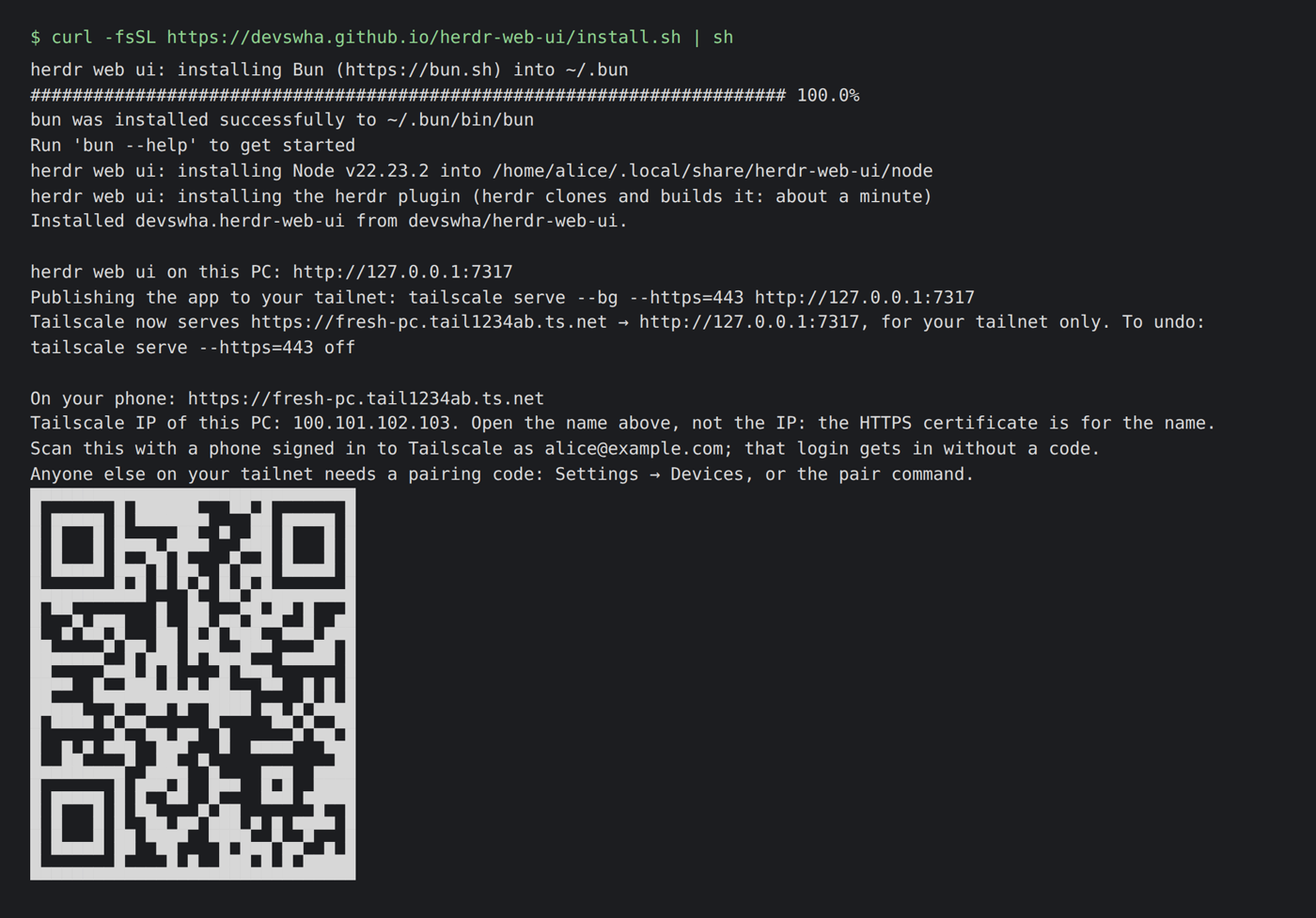
A PWA with a key bar above the keyboard that you can rearrange and extend with your own combinations, and a QR code to your Tailscale address. Your own Tailscale devices get in as you; any other device is paired once with a code.
Keep your workflow.
herdr owns the agents; this app connects to them. No wrapper command, no second daemon, no account. Update from Settings without stopping them, with patch notes for what each update brings.
Speak instead of typing.
Dictate into the chat or the terminal line, Korean and English mixed. Review the words before sending them to the agent; transcription uses your own OpenAI key or the browser's speech recognition.
Everything the agent touches, from either screen.
Switch to the live terminal

One click turns the chat into the pane's real terminal; on the phone, ↑ on the key bar brings back the test command and Enter runs it again.
Your herdr layout, in the browser

Every workspace, tab and split pane, with each agent's state: click a tab, pick a pane of a split, or switch workspaces from the phone.
Know when an agent needs you

On another workspace, an alert drops in when Claude asks; one tap opens its question.
Send a screenshot from your phone
The paperclip uploads it into the pane's folder and adds its path; Claude reads the image.

Open what the agent made
Click a path in the terminal, or tap it in the chat: the file opens right there.
Branch off a second agent
From the phone, ⋯ → New worktree: the branch is filled in, pick an agent, and it starts beside the first.
Each clip is a live recording of the desktop and a phone at once, in real time with no cuts. Click one for the full video.
Try it in your browser first.
The app itself, on a fictional session with made-up agents. Nothing in it is live, and nothing you type reaches a machine.
Other phone clients for herdr.
All four are in the herdr plugin marketplace. Each is described here in the words of its own README and docs, and each does something this app does not.
| What | herdr web ui | collie | roamgate | herdr-remote |
|---|---|---|---|---|
| Runs as | A herdr plugin. herdr builds it, starts it and it updates itself. | Its own bridge, from a curl installer or as a herdr plugin. | Its own server, from a curl installer or as a herdr plugin. | A macOS menu-bar or Windows tray app, plus a Python relay for the phone. |
| Drives | herdr | herdr, tmux or zellij | herdr | herdr |
| What you read | The agent's own transcript as a chat, with the work folded per turn. The live terminal for everything else. | Pane output, with a dashboard led by what needs your input. | Terminals, agent sessions, files and diffs. | An agent timeline and terminal output. |
| Answering | Prompt cards checked against the live menu, or the terminal. Dictation into either. | Prompts as tappable buttons, quick replies, voice input. | Typed into the terminal, from a composer or as direct keys. | One-tap approvals from the phone, the menu bar or Telegram. |
| Reaching your phone | Your Tailscale, SSH tunnel or HTTPS proxy. Your Tailscale login gets in; other devices are paired with a code. | Tailscale serve, or your own ingress. | Tailscale Serve, SSH forwarding or native HTTPS, behind a token or password. Web push. | A free Cloudflare tunnel, Telegram, web push. |
| Other machines | Linux, macOS and Windows PCs over SSH, added from Settings. | Crews: one collie per machine behind one URL. | SSH profiles to herdr on other Linux and macOS hosts. | The relay collects several machines. |
| Also | A viewer for the files agents make, web push, remote-PC bridges kept current with the app, and an interface in English, Chinese, Japanese and Korean. | Six UI languages, device pairing, output search, a read-only view of changes. | A file explorer with diff annotations, the Ranger assistant, and it can install herdr for you. | A daily digest, a TUI, a notch panel on a MacBook. |
Read as of October 2026. If you want tmux or zellij, diffs, Telegram or a tunnel out of the box, one of the others is the better fit.
- Can I use Claude Code or Codex from my phone?
- Yes. Run the agent in a herdr pane on your computer, and this app shows the same pane in your phone's browser: the agent's own transcript as a chat, its approvals and questions as cards you tap, and the live terminal a tap away. It installs to the home screen and sends a push alert when an agent needs you. Phone setup →
- Which agents does the chat view support?
- Claude Code, Codex, omp, omo, gjc and pi are read from their own session files. Any other program in a herdr pane gets the live terminal and its status. Supported agents →
- Does it replace herdr's own TUI?
- No. Both attach to the same terminals at the same time, so the pane stays live at your desk, in the browser and on the phone. Nothing is stopped or handed over. TUI and browser →
- Do I need Tailscale?
- No. Tailscale, an SSH tunnel, a VPN or your own HTTPS proxy can provide a route to the PC. Installation and push alerts need a secure context such as HTTPS or localhost; basic browsing also works over plain HTTP on a LAN. The options →
- Does my code or conversation leave my machine?
- Session files stay on the PC running each agent, and their contents are served to browsers you connect. The app has no hosted relay or account service of its own. Optional voice input sends audio (and text when polishing) to the configured provider; enabled usage meters contact provider APIs. Updates, remote-PC setup and push alerts can also use external services. The agents’ own model connections depend on their configuration. Data flow and access →
- Does it work on Windows?
- Yes, on Windows x64 without WSL. Until herdr can attach a terminal there, the terminal is a screen mirror with typing and a fixed grid.
- How is it different from Happy, Paseo or CloudCLI UI?
- Those projects provide their own ways to start or manage agent sessions. This app works with the herdr panes you already run, keeping the same terminals available in the TUI and browser. If you do not use herdr, compare those projects’ deployment options and agent support. The full comparison →
Take herdr with you.
Linux (x64, arm64) or macOS. It installs what is missing (herdr 0.9.0+, Bun 1.4+, Node 18+) for your user, then the app as a herdr plugin. With Tailscale running, it ends on a QR code for your phone.
curl -fsSL https://herdrweb.dev/install.sh | shWindows x64, in PowerShell: irm https://herdrweb.dev/install.ps1 | iex
It needs Git for Windows, and terminals there use the screen mirror.
Have herdr, Bun and Node already? herdr plugin install devswha/herdr-web-ui
Then open http://localhost:7317. It starts with herdr from then on.
run it from a checkout · INSTALL.md for a coding agent · access and safety →